
Kakejiku (Kakemono), Wall Scroll Painting
History of Kakejiku
The Heian Period (794 - 1192)

The most original style of Japanese hanging scroll came from China.
In the Early China, Buddhist missionaries carried Buddhistic paintings to spread their religion.
Until the reign of Tang regime (618-907) of China, that kind of Buddhistic paintings were used to be decorated and reinforced to be proof enough for carrying.
That's the archetype of hanging scrolls.
After Buddhism was introduced to Japan, such a decoration style of paintings was also introduced in the Heian Period of Japan.
The Muromachi Period (1334 - 1573)

During this period, Japan's original housing architecture had quite developed.
In that architecture style, there is one special room that is called "Tokonoma".
Most of artworks including hanging scrolls were displayed in this room.
Tokonoma was regarded as the space which connects art and daily life.
This is very original thought that can not be found in other countries.
The Momoyama Period (1573 - 1603)
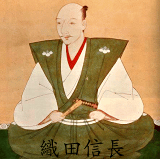
Two great sovereigns represent this period.
Oda Nobunaga & Toyotomi Hideyoshi.
They liked "Chanoyu" (=tea ceremony) very much.
Chanoyu tea ceremony was usually done in Tokonoma room.
Tokonoma architecture style was developed and established in this period.
Accompanied with the development of Tokonoma style, the techniques of painting and mounting were also developed because hanging scroll was always displayed in a Tokonoma room.
The Edo Period (1603 - 1868)

There were only a few big wars in this period in Japan.
As this period was so peaceful, each Japanese culture had reached full maturity.
Many famous painters flourished and competed each other.
Hanging scrolls also became popular among the public.
After the Meiji Era (1868 - )

Much more painters competed each other for their techniques because people became absolutely free to choose their occupations after the Meiji Restoration in 1868.
Before the Second World War, and for a while after that war, most of Japanese painting artworks were used to be decorated to hanging scrolls.
By reasons of the above, now, we can enjoy high-quality hanging scrolls made after the Meiji era.
How to Treat Kakejiku

Kakejiku (hanging scroll) is made from silk, Japanese paper, wood & special glue.
Kakejiku hates an environment that is too moist or too dry.
Please pay attention to the following to keep it in good condition.
- Please do not hang the Kakejiku in a room in which the air conditioner is working excessively.
- When storing, please keep the Kakejiku away from moisture.
- Please give an airing in the shade twice a year.
- Please do not leave Kakejuki hanging for a long time. Sometimes, roll it up.
- When storing, please do not roll Kakejiku up too tightly.
Fuchin (Scroll Weights)

Scroll weights are called "Fuchin" in Japanese.
A pair of Fuchin is hung on from roller ends of hanging scroll.
These scroll weights add much more tasteness.
In addition, scroll weights take creases out as they have appropriate weight of their own.
They also prevent a hanging scroll from swinging in the wind.
Kiribako (Wooden Box)
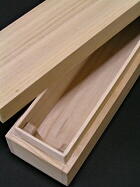
We often use wooden boxes made of paulownia tree ("kiri" tree in Japanese) for storing hanging scrolls.
The box made of paulownia is called "kiribako".
Paulownia tree is the best material for storage because of the following three reasons.
Both the extension percentage & contraction percentage of the paulownia material are very small.
Therefore, we can make storage boxes that are more airtight than those made of any other wood material (= Paulownia box has no airleakage.)
This feature of paulownia box prevents air from circulating.
Paulownia box maintains the inside at constant humidity so that it protects its contents from corrosion.
Paulownia is the most lightweight tree in Japan even though it is strong and rigid. (= The density is the lowest.)
It is convenient to carry.
Insects and worms hate some of the ingredients extracted from paulownia.
So, paulownia boxes keep those unwelcome insects away.
